Lagoon Sludge Treatment
Biological sludge reduction for wastewater lagoons, matched to your water temperature. Tablets, water-soluble packets and granular oxygen, dosed to your acreage.
Short answer
Biological sludge treatment reduces the organic fraction of a lagoon blanket in place, at a fraction of dredging cost. The product you need depends on water temperature: cold-water formulations work down to 34 degrees, standard blends run 65 to 78 degrees, and high-heat blends take over above 78. Dosing is set by surface acreage.
What we carry
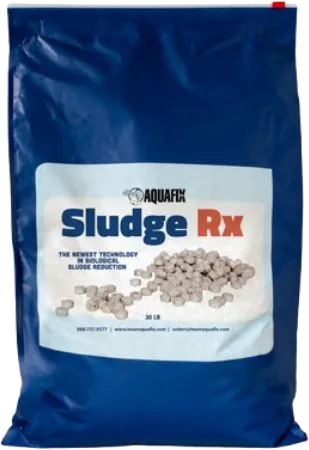
Sludge Rx
For: a sludge blanket that keeps growing year over year
Bacterial and biostimulant tablets that sink to the lagoon blanket and digest organic sludge in place. 30 lb bag, dosed at 60 lb per acre per month.
Polar Rx
For: a sludge program that stops working every october
Cold-water bacterial and biostimulant tablets for lagoon sludge reduction between 34 and 60 degrees F. 30 lb bag, dosed at 60 lb per acre per month.
VitaStim Sludge Reducer
For: sludge accumulating faster than the cell digests it
Water-soluble packets of 23 vitamins, biostimulants, biocatalysts and select species for lagoon sludge and BOD reduction between 65 and 78 degrees F.
VitaStim Summer Slam
For: a lagoon that struggles every summer in the same way
High-heat lagoon blend of 23 vitamins, biostimulants, biocatalysts and select species for water above 78 degrees F. Thrown from shore, dosed by acre.
VitaStim Polar
For: effluent bod climbing as water temperature drops
Cold-weather lagoon blend of 23 vitamins, biostimulants, biocatalysts and cold-adapted species, working down to 41 degrees F. Thrown from shore.
OxyPaks XL
For: a dead zone or deep corner the aerators do not reach
Granular oxygen source that sinks into the lagoon sludge layer, releasing oxygen to accelerate digestion and offset the anaerobic conditions behind odor.
Which one for which problem
| Product | Reach for it when | Form | Applied from | Timeline |
|---|---|---|---|---|
| Sludge Rx | A sludge blanket that keeps growing year over year | Sinking tablet, 30 lb bag | Boat or shore, over the blanket | Months to a full season |
| Polar Rx | A sludge program that stops working every October | Sinking tablet, 30 lb bag | Boat or shore, over the blanket | Across the cold season |
| VitaStim Sludge Reducer | Sludge accumulating faster than the cell digests it | Water-soluble packet, 30 lb container | Shore, no boat required | A spring and autumn program |
| VitaStim Summer Slam | A lagoon that struggles every summer in the same way | Water-soluble packet, 30 lb container | Shore, no boat required | Across the hottest months |
| VitaStim Polar | Effluent BOD climbing as water temperature drops | Water-soluble packet, 30 lb container | Shore, no boat required | Across the cold season |
| OxyPaks XL | A dead zone or deep corner the aerators do not reach | Granular, 50 lb container | Shore or boat, over the target zone | Days for odor, weeks for digestion |
Plenty of systems run more than one of these. They are complementary far more often than they are alternatives, and each product page says which it pairs with and why.
Before anything on this page is worth buying, profile the blanket. A sludge survey tells you volume, distribution and composition, and composition is what decides whether biology is even applicable.
Match the product to your water temperature
This is the part most catalogs leave you to work out yourself. Biological rates track water temperature, so the same lagoon needs a different formulation in February than it does in August. The AquaFix line is banded deliberately.
| Water temperature | Product | Form |
|---|---|---|
| 34 to 60 degrees F | Polar Rx | Sinking tablet |
| 41 degrees F and up | VitaStim Polar | Water-soluble packet |
| 65 to 78 degrees F | VitaStim Sludge Reducer | Water-soluble packet |
| Above 78 degrees F | VitaStim Summer Slam | Water-soluble packet |
| Warm months, targeted | Sludge Rx | Sinking tablet |
| Any, as an oxygen boost | OxyPaks XL | Granular |
A year-round program usually means two products rather than one: a warm-season blend through summer and a cold-water blend through winter, so the biology never fully stops working on the blanket.
Then match the form to the problem
Sinking tablets deliver bacteria and biostimulants straight to the sludge-water interface. That is the right tool when a survey shows a deep, localised accumulation, typically at the inlet end, and when the water column above it is stratified enough that anything applied at the surface would not reach the bottom.
Water-soluble packets are thrown from the bank and treat the whole cell. They suit an even blanket across the basin, and they suit small systems: no boat, no dosing equipment, no second operator, which is frequently the difference between a program that runs on schedule and one that gets postponed.
Granular oxygen is a spot treatment for the anoxic zones no aeration layout reaches. It is a companion rather than a standalone answer, because in a dead zone the bacteria are limited by oxygen before anything else.
Fix aeration first, if aeration is the problem
If your blanket is growing year over year, the cell is not mixed well enough to digest what arrives. Adding a bacterial product to an anoxic, stratified cell is fighting uphill. Documented aeration upgrades have produced year-over-year effluent improvements on the order of 57 percent in TSS and 39 percent in CBOD, and a properly mixed cell banks far less sludge going forward.
The sequence that works is: survey the blanket, profile dissolved oxygen, correct aeration if it is short, then run the biological program. The sludge removal guide covers the full decision framework including when to skip straight to mechanical removal.
Verifying the program
Same grid points, same tool, same method, before and after. Anything less than that is an impression rather than a measurement, and a program you cannot verify is a program you cannot justify to a board next budget cycle.
Common questions
Which sludge product do I need?
Water temperature decides it first. Polar Rx and VitaStim Polar work in cold water, VitaStim Sludge Reducer covers 65 to 78 degrees, and VitaStim Summer Slam is the high-heat blend above 78. Then choose form: tablets sink to the blanket for targeted work, water-soluble packets treat the whole cell from shore.
How do I know if biological treatment will work on my lagoon?
Two conditions decide it. The blanket has to be predominantly organic rather than grit and mineral solids, and the cell has to have adequate oxygen and mixing. A sludge survey answers the first and a dissolved oxygen profile answers the second. Both should happen before you buy anything.
How long does a biological sludge program take?
Months and seasons, not weeks. Dosing is set to your lagoon's acreage and load, and the honest verification is a sludge survey on the same grid points before treatment and again at season's end.
Can biological treatment replace dredging?
Sometimes it defers it for years, sometimes it only slows re-accumulation. It cannot remove grit, plastics or mineral solids, and it is not a substitute for dredging a cell that has lost most of its depth. The two combine well: biological reduction before a dredge shrinks the dry tonnage you eventually pay to haul.
Do I need to run something year round?
Many systems do, because the reason a blanket grows is that accumulation outpaces digestion, and that continues through winter when biology slows. The temperature-banded products exist so a program can carry across seasons rather than stopping in October and restarting in June.
Read before you buy
Lagoon Sludge Removal: Costs, Options, and How to Decide
Dredging vs biological sludge reduction for wastewater lagoons: real cost ranges, how to measure your sludge blanket, and a decision framework.
SludgeLagoon Sludge Judging: How to Measure Your Sludge Blanket
The grid method for profiling a wastewater lagoon sludge blanket, the tools it takes, and how to convert probe readings into volume and dry tons.
AerationWastewater Lagoon Aeration: The Operator's Complete Guide
How lagoon aeration works, surface vs diffused systems, sizing basics, winter operation, and how to choose the right aerator for your cells.