Sludge Rxformulated by AquaFix
Sludge Rx
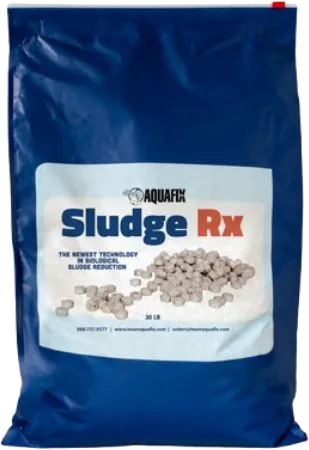
Bacterial and biostimulant tablets that sink to the lagoon blanket and digest organic sludge in place. 30 lb bag, dosed at 60 lb per acre per month.
What it is
Sludge Rx is a dense tablet that sinks through the water column and works at the sludge-water interface, combining bacterial strains with biostimulants to digest organic solids where they sit. Lagoon dosing is 60 lb per acre once per month. It lowers blanket thickness, effluent TSS, ammonia and phosphate.
Buy this when you are seeing
- A sludge blanket that keeps growing year over year
- Effluent TSS spikes you cannot trace to anything current
- A dredging quote you cannot fund this budget cycle
- Deep accumulation at the inlet end that surface treatment will not reach
How it works
Most lagoon treatments are added to the water and rely on reaching the blanket by chance. A dense tablet removes that step: it sinks through the water column and begins working at the sludge-water interface, which is where the organic fraction of the blanket actually is. In a stratified cell, that difference decides whether the treatment reaches its target at all.
The formulation pairs bacterial strains with custom biostimulants. The bacteria digest organic solids; the biostimulants raise the productivity of the population already present, which in a nutrient-skewed lagoon is frequently the larger of the two effects. The result is dense sludge converted into bacterial biomass rather than accumulating.
Effluent chemistry moves with the blanket. As the organic fraction is digested, the manufacturer reports lower effluent TSS, ammonia, phosphate and coliforms, along with more stable pH. That follows from removing the source: an anaerobic blanket is a continuous internal load on the cell above it.
Check these before you buy
These decide whether this product can work at all. If one fails, fix that first, because the money spent here will not survive it.
- Confirm the blanket is predominantly organicBiology reduces organic solids. It does nothing to grit, plastics or mineralised sludge. A sludge survey that notes composition at each grid point answers this before you spend anything.
- Confirm the cell has adequate oxygen and mixingBacteria added to an anoxic, stratified cell face the same conditions that created the blanket. Pair with OxyPaks XL where the profile shows dead zones, or correct aeration first.
- Check water temperatureThis is the warm-weather formulation. Below about 60 degrees F, Polar Rx is the cold-water tablet built for the same job.
- Record baseline readings on a fixed gridWithout a before measurement there is no after. Same points, same tool, same method, or the season ends with an impression instead of a result.
Is this the right fit
Good fit for
- Predominantly organic blankets confirmed by a survey
- Deep or localised accumulation, typically at the inlet
- Sludge storage basins as well as treatment cells
- Reducing dry tonnage ahead of a planned dredge
- Budgets that cannot absorb a dredging project this cycle
Not the answer for
- Grit, plastics or mineralised sludge, which biology cannot touch
- Cold water, where Polar Rx is the correct formulation
- Cells that have lost most of their design depth
- Getting capacity back before the end of this season
Dosing and application
- Lagoon dose
- 60 lb per acre, once per month.
- Aeration basin dose
- 30 lb per 10,000 square feet, twice per month.
- Placement
- Distributed over the blanket rather than at a single point, weighted toward the inlet end and any dead zone where the survey shows accumulation concentrating.
- Season
- Apply during warm months. Biological rates follow water temperature, and cold water slows the organisms you add exactly as much as the ones already there.
- Volume pricing
- $18.00/lb for 1 to 9 bags, $13.50/lb for 10 to 29 bags, $10.33/lb at 30 bags and up. Multi-cell systems and multi-season programs usually reach the second tier.
What to expect, and when
- Before you startSludge survey on a fixed grid, dissolved oxygen profile by depth and location, and current BOD, TSS and ammonia.
- First weeksNothing visible, and that is normal. Biological reduction works at the pace bacteria work. Anyone promising a change you can see in a fortnight is selling something else.
- Through the seasonEffluent TSS is usually the first number to move, because reducing the blanket removes the source of the intermittent solids carry-over at the effluent structure.
- End of seasonRe-survey the same grid points. The comparison is the deliverable, and it is what goes in front of a council or board next budget cycle.
How you prove it worked
Sludge judge the same grid points with the same tool and the same method, before treatment and again at season's end. That comparison is the only honest verification. A general impression that the cell looks better is not evidence, and it will not survive a question from a board member.
Sludge is one of the two root causes behind most lagoon failures, and it is the expensive one. Industry estimates put average dredging costs around $350 per dry ton, against blankets that commonly run 2,500 to 5,000 dry tons in mid-sized municipal lagoons. That arithmetic is why a biological program is worth running even when it will not replace a cleanout outright: every ton digested in place is a ton you do not pay to dewater, haul and dispose of later.
What makes a direct-to-sludge tablet different from a general lagoon treatment is where the work happens. The organic fraction that can be reduced sits on the bottom, under a water column that in many cells is stratified and short of oxygen. Delivering the bacteria and biostimulants to that interface, rather than to the surface, is the whole design intent.
Set expectations honestly at the start, because that is what separates a program that gets renewed from one that gets blamed. This is measured in months and seasons. It is dosed against your acreage. And it is verified by sludge judging the same grid points before and after, which is the number that belongs in front of a board.
Specifications
| Manufacturer | AquaFix |
|---|---|
| Type | Bacterial and biostimulant tablet |
| Target | Organic fraction of the sludge blanket |
| Application | Direct to sludge, sinks through the water column |
| Lagoon dose | 60 lb per acre, once per month |
| Aeration basin dose | 30 lb per 10,000 sq ft, twice per month |
| Pack size | 30 lb bag |
| Temperature range | Warm months; see Polar Rx for cold water |
Works alongside
Common questions
How much do I need for my lagoon?
The lagoon rate is 60 lb per acre once per month, so a 30 lb bag covers half an acre for one month. A three-acre cell runs six bags a month, which puts a season-long program into the second volume tier.
Why a tablet rather than a liquid or powder?
Because the target is the blanket, not the water above it. A dense sinking tablet delivers the bacteria and biostimulants to the sludge-water interface directly instead of relying on them settling out of the water column on their own, which matters most in exactly the stratified cells that build the worst blankets.
How long before I see anything?
Months and seasons, not weeks. Effluent TSS is usually the first number to move. The blanket measurement itself is compared at the end of the season against your baseline survey, which is the honest way to read it.
Can this replace dredging?
Sometimes it defers dredging for years, sometimes it only slows re-accumulation. It cannot remove grit or mineral solids and it will not rescue a cell that has lost most of its depth. The two combine well: biological reduction before a dredge shrinks the dry tonnage you eventually pay to haul.
What should I run in winter?
Polar Rx, which is the same direct-to-sludge tablet approach formulated for 34 to 60 degree F water. Systems that run one through summer and the other through winter keep the blanket under continuous attack rather than losing half the year.
Do I need aeration for this to work?
Adequate oxygen and mixing, yes. Where a dissolved oxygen profile shows a genuinely anoxic zone, OxyPaks XL supplies oxygen locally so the bacteria have something to work with. If the whole cell is short, correct aeration first.
Read before you buy
Lagoon Sludge Removal: Costs, Options, and How to Decide
Dredging vs biological sludge reduction for wastewater lagoons: real cost ranges, how to measure your sludge blanket, and a decision framework.
SludgeLagoon Sludge Judging: How to Measure Your Sludge Blanket
The grid method for profiling a wastewater lagoon sludge blanket, the tools it takes, and how to convert probe readings into volume and dry tons.
AerationWastewater Lagoon Aeration: The Operator's Complete Guide
How lagoon aeration works, surface vs diffused systems, sizing basics, winter operation, and how to choose the right aerator for your cells.